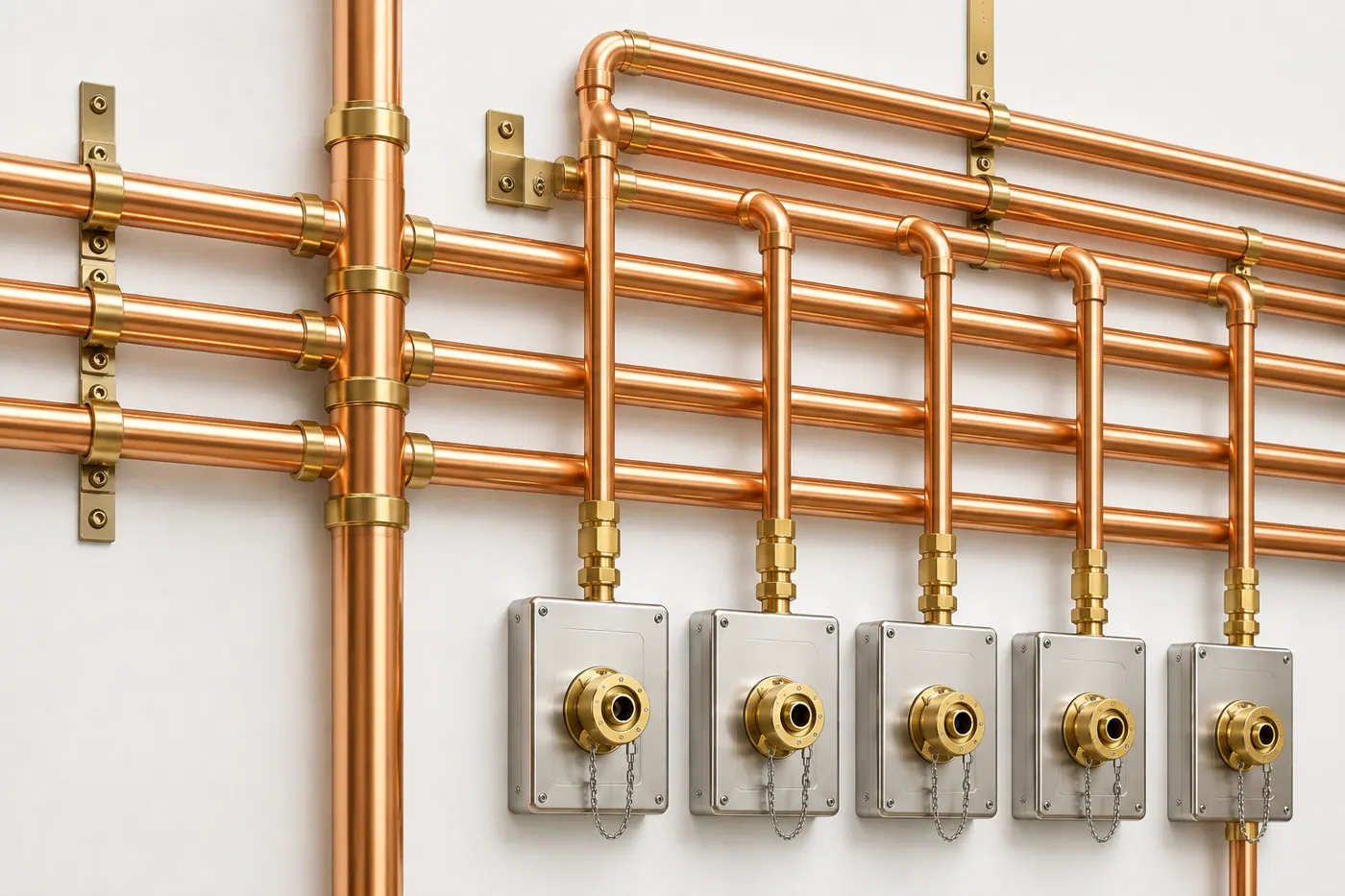
Central Gas Supply
The MGPS begins at the approved gas source, which may include manifolds, cylinder banks, bulk storage systems or other specified supply arrangements.
Medical Gas Pipeline System | MGPS
End-to-end Medical Gas Pipeline System solutions for hospitals and healthcare facilities — covering engineering design, medical gas pipeline installation, testing, commissioning and long-term maintenance for critical clinical areas.
01
Engineering Design
02
Pipeline Installation
03
Testing & Commissioning
04
AMC / CMC Support
01
Manifolds, cylinder banks, bulk storage or other approved sources supply the hospital pipeline network.
02
Dedicated medical gas pipelines distribute the required gases to clinical departments and patient care areas.
03
Valve service units and alarm systems support isolation, monitoring and response to abnormal conditions.
04
Gas-specific terminal outlets provide controlled access at beds, operating theatres and critical care workstations.
Understanding MGPS
A Medical Gas Pipeline System (MGPS) is a permanently installed healthcare infrastructure network designed to distribute medical gases and vacuum from approved supply sources to designated clinical locations.
Instead of relying on individual cylinders at every patient location, a centralised pipeline system allows gases such as oxygen, medical air and vacuum to be delivered through dedicated distribution networks to patient beds, intensive care units, operating theatres, recovery areas, emergency departments and other clinical locations.
A properly engineered MGPS is not simply a network of copper pipes. It is a complete safety-critical system involving the source of supply, pressure regulation, distribution pipework, isolation valves, alarms, terminal outlets, identification, testing, commissioning and documentation.
Suggested diagram: MGPS source → manifold → pipeline → zone valve → alarm → terminal outlet
Clinical Infrastructure
Medical gases are directly connected with patient care, anaesthesia, respiratory support, surgical procedures and critical clinical equipment. The pipeline infrastructure therefore has to provide the correct gas, at the required location and under controlled operating conditions.
Gas-specific outlets and identification systems are intended to reduce the risk of connecting the wrong gas to clinical equipment or patient care.
A properly planned supply arrangement can support continuity of service through appropriate primary and alternate supply arrangements.
Centralised gas distribution reduces dependence on moving cylinders through clinical areas and supports organised infrastructure around patient care spaces.
Appropriate monitoring and alarm arrangements help clinical and engineering teams identify abnormal pressure or supply conditions.
Inspection, testing and preventive maintenance help maintain the operational reliability of critical medical gas infrastructure.
Testing and commissioning records provide evidence that the installed system has been checked before clinical use.
Gas Services
The gases included in a hospital pipeline depend on the clinical departments, medical equipment, treatment requirements and project design. ISO 7396-1 covers pipeline systems for compressed medical gases and vacuum, including oxygen, nitrous oxide, medical air, carbon dioxide and vacuum, among other specified gases and applications. :contentReference[oaicite:1]{index=1}
O₂
Medical oxygen is used across patient care areas for oxygen therapy, respiratory support, anaesthesia-related applications and other clinical requirements as specified by the healthcare facility.
AIR
Medical air is supplied for clinical applications and for equipment that requires a clean compressed air source.
VAC
Vacuum systems provide suction services for clinical procedures, patient care and equipment applications through dedicated vacuum pipeline networks.
N₂O
Nitrous oxide may be distributed through dedicated pipeline infrastructure where required by the hospital's clinical services and applicable regulations.
CO₂
Carbon dioxide pipeline distribution may be provided for specialised clinical applications where included in the project requirements.
AGSS
Anaesthetic gas scavenging is a separate system intended to collect and dispose of waste anaesthetic gases from relevant clinical areas.
System Architecture
An MGPS should be considered as a complete engineered system rather than only a pipe network. Supply sources, controls, distribution, monitoring, isolation and terminal equipment work together to provide the required clinical services.
Diagram placeholder — MGPS architecture from source to clinical outlet
The source system supplies the medical gas into the distribution network. Depending on the project, this may involve cylinder manifolds, bulk systems, medical air compressors, vacuum plants or other approved supply arrangements.
Manifolds manage the connection of cylinder banks and the changeover of supply arrangements according to the designed system configuration.
Dedicated pipeline networks distribute each gas to designated clinical areas. Routing and sizing are determined through engineering design and project requirements.
Area valve service units allow designated pipeline sections to be isolated for maintenance or emergency response while supporting controlled access to the system.
Alarm systems provide monitoring of relevant supply or pressure conditions and help engineering or clinical teams respond to abnormal operating conditions.
Terminal outlets provide gas-specific connection points for clinical equipment at patient beds, operating theatres, intensive care areas and other designated locations.
Pipeline Engineering
Medical gas pipework requires careful material selection, preparation, installation and jointing because the pipeline is part of a safety-critical clinical infrastructure system.
Copper tube systems are commonly used for medical gas distribution. The selected material, cleanliness requirements, dimensions, jointing method and installation procedure should follow the applicable project specification and governing standards.
During installation, pipe cleanliness and protection from contamination are particularly important. Brazed joints and other installation processes must be executed using the specified procedure and controlled workmanship.
Suggested image: medical gas copper pipeline routing and jointing detail
Engineering Design
MGPS design starts with understanding how the hospital operates. Gas requirements cannot be determined from floor area alone. Clinical departments, patient capacity, equipment, simultaneous demand, future expansion and the hospital's operating model all influence the engineering design.
Identify departments, bed numbers, critical care requirements, operating theatres, procedure rooms and equipment requirements.
Establish design demand, diversity and future requirements for the proposed medical gas services.
Develop practical routing for risers, corridors, clinical areas, valve zones and terminal outlets.
Prepare drawings, schedules, specifications, testing plans and commissioning documentation appropriate to the project.
Hospital Applications
MGPS infrastructure is planned according to the clinical requirements of each department. The number and type of outlets, gas services and isolation zones should be determined during project design.
Oxygen, medical air and vacuum infrastructure for critical care patient stations and associated equipment.
Medical gas services supporting anaesthesia, surgical procedures and operating theatre equipment.
Rapid-access medical gas infrastructure for emergency treatment and resuscitation areas.
Specialised medical gas distribution planned around neonatal and paediatric critical care requirements.
Gas and vacuum outlets for post-operative recovery and procedure-based clinical services.
Bed-head medical gas outlets and supporting infrastructure based on department-level clinical requirements.
Suggested image: Area Valve Service Unit + Medical Gas Alarm Panel
Safety & Monitoring
Medical gas infrastructure needs controlled isolation and monitoring so that engineering teams can respond to maintenance requirements or abnormal conditions without treating the entire hospital pipeline as a single uncontrolled network.
Area valve service units and alarm systems form an important part of the system architecture. Their location, configuration and monitoring functions should be determined from the hospital layout, clinical zoning and applicable project requirements.
Validation
Installation is only one part of an MGPS project. Before the system is placed into clinical service, appropriate testing, verification, commissioning and documentation are required. ISO 7396-1 explicitly addresses testing, commissioning and documentation of medical gas pipeline systems. :contentReference[oaicite:2]{index=2}
Pipeline sections are tested according to the approved testing procedure and applicable requirements before commissioning.
Verification is performed to confirm that each pipeline is correctly connected to its intended gas service.
Terminal outlets are checked to verify the identity of the gas service before the system is released for clinical use.
Appropriate checks are carried out to identify leakage, integrity or installation-related problems.
Relevant alarm and monitoring functions are checked against the approved system design.
Test results, commissioning records, drawings and other required documentation are compiled for project handover.
NEW HOSPITAL
For a new hospital, MGPS planning should be integrated with the architectural, structural, HVAC, electrical, plumbing, fire-safety and medical equipment design process.
Early coordination helps establish plant-room locations, vertical risers, ceiling routes, valve zones, outlet positions and future expansion provisions before construction reaches critical stages.
EXISTING HOSPITAL
Existing hospitals may require pipeline extensions, department upgrades, additional bed-head outlets, OT modifications, replacement of ageing components or changes to the supply infrastructure.
Work in an operating hospital requires careful shutdown planning, temporary supply arrangements where required, isolation procedures and coordination with clinical and engineering teams.
MGPS System Overview
A Medical Gas Pipeline System connects the hospital's approved gas sources to clinical areas through a controlled distribution network. Each part of the system has a defined role in maintaining safe, reliable and continuous medical gas availability.
The MGPS begins at the approved gas source, which may include manifolds, cylinder banks, bulk storage systems or other specified supply arrangements.
Dedicated medical gas pipelines distribute the required gases from the source to wards, ICUs, operating theatres, emergency areas, recovery rooms and other clinical departments.
Area valve service units and alarm systems allow designated sections of the hospital network to be isolated, monitored and managed when abnormal conditions occur.
Gas-specific terminal outlets provide controlled access to medical gases at patient beds, operating theatres, ICUs, critical care workstations and other designated clinical locations.
MGPS FLOW
Clinical Gas Services
Different clinical areas require different medical gases and vacuum services. An MGPS connects the approved supply source to designated terminal outlets through a planned distribution network, allowing healthcare teams to access the required services where they are needed.
Distributed to clinical areas where oxygen therapy and respiratory support are required, including patient care areas and critical care environments.
A clean compressed-air service supplied to designated clinical equipment and patient-care areas according to the healthcare facility's system design requirements.
Central vacuum distribution provides suction service at designated outlets for clinical procedures and equipment requiring controlled negative pressure.
Where specified by the healthcare facility, nitrous oxide can be distributed through dedicated pipeline services to designated operating and clinical areas.
Anaesthetic gas scavenging systems are designed to collect and remove waste anaesthetic gases from designated operating and anaesthesia areas.
CRITICAL AREA 01
Medical gas outlets and related services are planned around surgical, anaesthesia and critical equipment requirements.
CRITICAL AREA 02
Bedside gas and vacuum services support clinical equipment and patient-care requirements in intensive and critical care areas.
CLINICAL AREA 03
Terminal outlets can be positioned according to bed layout, clinical workflow and the healthcare facility's engineering requirements.
Engineering note: The gases, outlet types, pressure requirements, pipeline routing and system configuration should be determined from the healthcare facility's clinical requirements, engineering design and applicable project standards.
MGPS Products
Explore the essential products and equipment used in Medical Gas Pipeline System installations, from gas source and control equipment to pipeline components, zone isolation, alarm systems and terminal outlets.
Gas manifolds, automatic changeover systems, pressure regulation and source-side equipment for controlled medical gas supply.
Medical-grade copper tubing and associated fittings used for dedicated oxygen, medical air, vacuum and other specified gas distribution lines.
Area valve service units, isolation valves and related control assemblies for managing individual clinical zones.
Gas-specific terminal outlets designed for designated patient care areas, operating theatres, ICUs and other clinical locations.
Master and area alarm systems for monitoring specified medical gas conditions and providing visual and audible alerts.
Pressure control and indication components used at appropriate points within the medical gas distribution system.
Clinical service units integrating medical gas outlets and electrical or equipment interfaces according to the application.
Supporting components and accessories required for complete medical gas pipeline installation, connection and maintenance.
Looking for a specific MGPS component?
Browse the complete product range and technical specifications.